Materiality in practice: choosing the benchmark and percentage, and documenting why

Materiality is one of the first numbers on an audit file and one of the first a reviewer questions. ISA 320 gives no formula: it treats materiality as professional judgement. So the work is to choose a benchmark and percentage you can defend, and to write down why.
Three thresholds, not one
- Overall materiality: the amount for the financial statements as a whole. Misstatements are material if they could reasonably be expected to influence users' economic decisions.
- Performance materiality: an amount set below overall materiality, to reduce to an appropriately low level the probability that uncorrected and undetected misstatements, added together, exceed it. ISA 320 says it is not a simple mechanical calculation: it reflects your understanding of the entity, your risk assessment and past misstatements.
- Clearly trivial threshold (ISA 450): the level below which misstatements need not be accumulated. "Clearly trivial" is not another expression for "not material": it is a wholly different, smaller order of magnitude, and if you are unsure, treat the item as not clearly trivial.
How the last two derive from overall materiality is for your firm's methodology.
Choosing the benchmark
ISA 320 names no single benchmark. Its examples: profit before tax, total revenue, gross profit, total expenses, total equity or net assets. Its factors: what users focus on (profit, revenue or net assets); the entity's nature, stage and industry; ownership and financing (if financed solely by debt, users may weigh assets more than earnings); and the benchmark's volatility. Profit before tax is often used for profit-oriented entities, but when it is volatile other benchmarks may fit better. For an owner-managed company whose profit is nominal because the owner draws it as remuneration, the standard mentions profit before remuneration and tax.
Choosing the percentage
ISA 320 says a percentage on profit before tax will normally be higher than one on revenue. Its examples are 5% of profit before tax for a profit-oriented manufacturer and 1% of total revenue or total expenses for a not-for-profit entity; higher or lower may be appropriate. Published practitioner material gives wider ranges, and they differ:
- An examiner's article for CPA Ireland: revenue 0.5% to 1%, total assets 1% to 2%, net assets 2% to 5%, profit after tax 5% to 10%, and 0.5% to 1% of expenses for a not-for-profit or public body. Higher assessed risk points to the lower end; many auditors use 60% to 75% of materiality as performance materiality.
- A 2019 Belgian auditors' institute paper on regulatory returns, as indicative: 5% to 10% of profit before tax, 1% to 3% of revenue, assets or equity, 1% to 5% of expenses; every network has its own guidance.
Read these as commonly cited practice, not rules. Your firm's methodology decides.
A worked example (invented company)
An invented trading company, in JOD, round numbers for illustration: revenue 10,000,000; total expenses 9,700,000; profit before tax 300,000; total assets 4,000,000.
| Benchmark | Amount | Percentage | Result |
|---|---|---|---|
| Profit before tax | 300,000 | 5% | 15,000 |
| Revenue | 10,000,000 | 0.5% | 50,000 |
| Total assets | 4,000,000 | 1% | 40,000 |
Profit is only 3% of revenue and can swing, so 5% of it lands far below the others. Suppose the reviewer judges that users follow turnover and chooses revenue at 0.5%: overall materiality 50,000. With illustrative ratios of 75% and 5%, performance materiality is 37,500 and the clearly trivial threshold 2,500. Another firm could choose differently. What matters is the sentence in the file saying why.
Documenting why
ISA 320 asks the file to show these amounts and the factors considered: overall materiality, any levels for particular classes of transactions, balances or disclosures, performance materiality, and any revision. A rationale that survives review answers five questions:
- Who uses these statements, and what do they look at?
- Why this benchmark and not the alternatives, with their amounts?
- Is the benchmark stable, or normalised, and how does it compare with last year?
- Why this percentage within your firm's range, given your risk assessment?
- Who set it, who reviewed it, and when?
"5% of profit before tax, per firm policy" answers none of them.
When to revise
Revise when you learn something during the audit that would have led to a different amount at the start. ISA 320's examples: a decision to dispose of a major part of the business, or actual results likely to differ substantially from the anticipated ones used at the start. If materiality goes down, decide whether performance materiality and the further procedures remain appropriate. ISA 450 also has you reassess materiality before evaluating uncorrected misstatements. Record the revision and why, and keep the original.
From the trial balance to the working paper
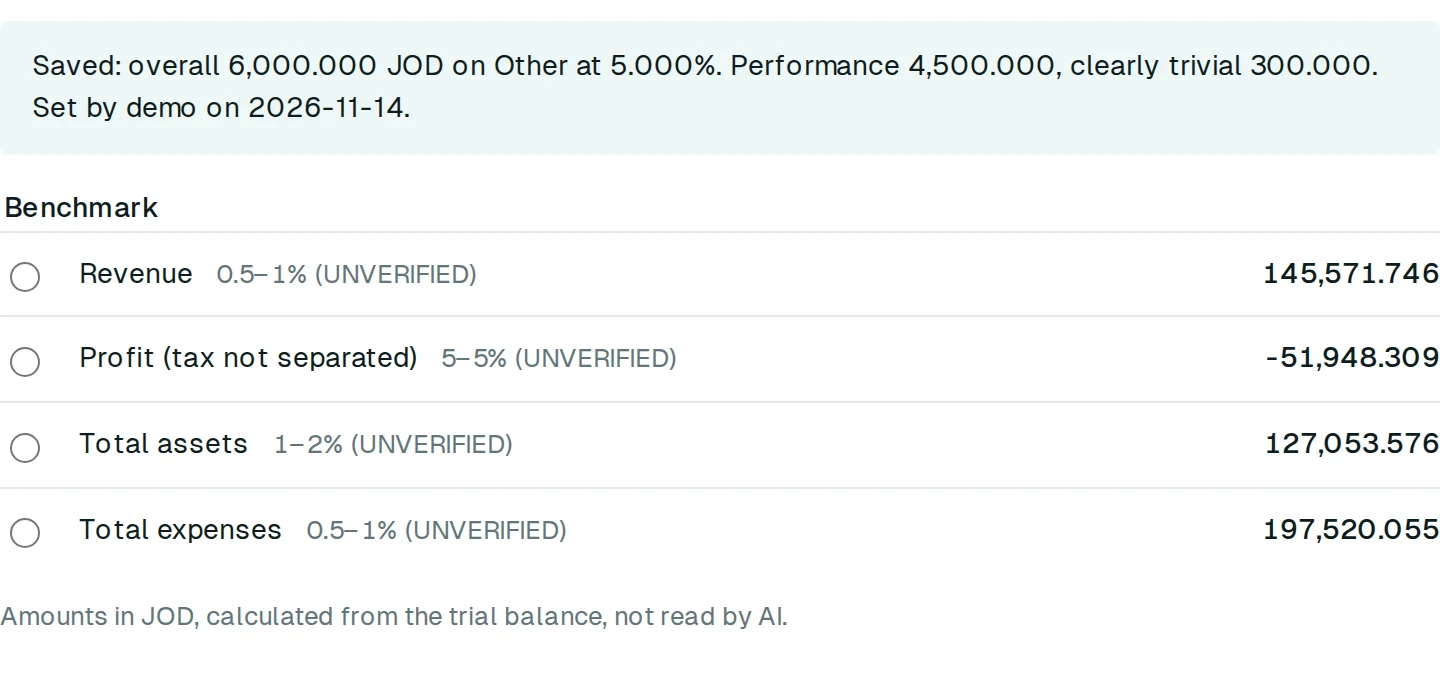
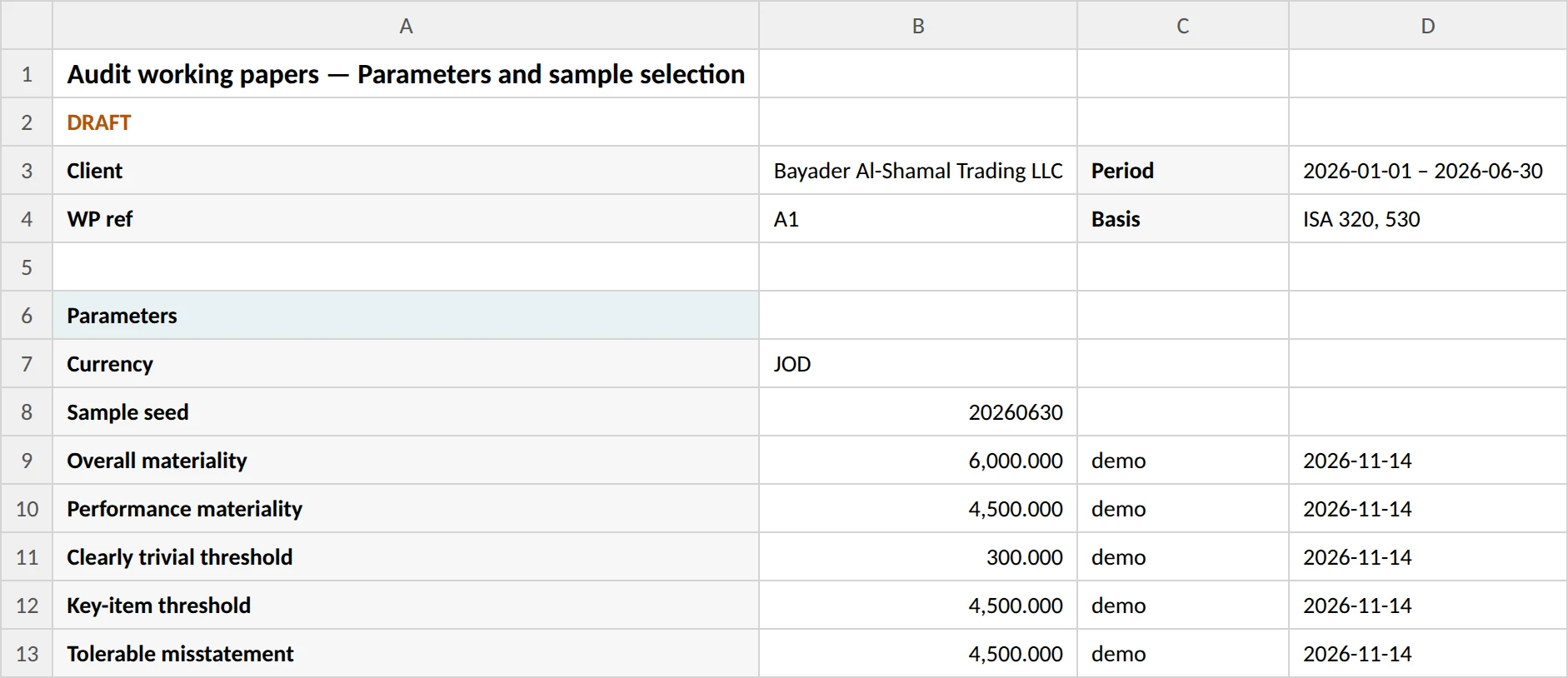
Zimam lists the benchmarks it can compute from the trial balance; you choose one, enter your percentage and write the reason, and the figures land in the Excel working paper with your name. The determination stays with you (ISA 320).
Sources
- IAASB, ISA 320, Materiality in Planning and Performing an Audit (2013 handbook edition: definitions, benchmark factors and examples, revision, documentation).
- ISA (UK and Ireland) 450, accumulation of identified misstatements and "clearly trivial", Chartered Accountants Ireland (2010 edition).
- Danielle McWall, Materiality and its practicalities, CPA Ireland (benchmark and performance materiality ranges).
- IREFI/IRAIF paper hosted by the IRE/IBR (Belgian Institute of Registered Auditors), Determining materiality and performance materiality, 2019 (indicative ranges, regulatory returns).
This article is general information, not professional advice; it does not replace your firm's methodology or the auditing standards adopted in your country.