A client with several bank accounts and a USD account: organising statements and confirmations
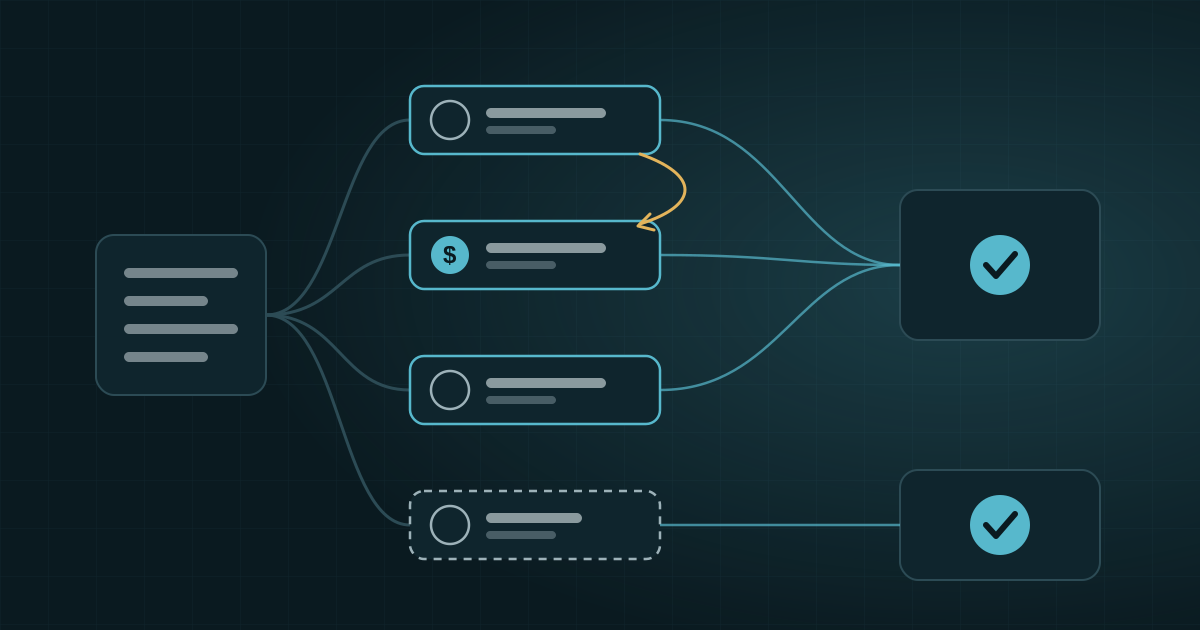
Some audit files involve more than one bank account: a current account in dinars, a dollar account, perhaps a facilities account or an account closed during the year. When the statements are treated as one file, the evidence gets mixed up: a ledger line on one account is matched to another account's statement, and one confirmation is taken to cover several banks.
This article describes a method you can apply in Excel today. The idea is that the unit of work is the account, and a confirmation is requested per bank but tracked per account.
1. Start with an account register
Build one row for every bank account, from three sources: the trial balance, the list of accounts the client provides, and the banks' replies as they arrive:
| Trial-balance account | Bank | Last 4 digits | Currency | Status | Statements available (from-to) | Confirmation |
|---|---|---|---|---|---|---|
| ... | ... | ... | dinar / dollar | active / opened / closed / dormant | ... | ... |
Then check in both directions: every account in the trial balance has statements covering the period, and every statement belongs to an account in the trial balance. A statement with no matching ledger account is not a detail to drop, and should not be assigned to another account by guesswork. It is a completeness question, because it may be an account missing from the books. Ask the client, and keep the answer and the evidence.
Register and confirmation tracker as a spreadsheet
Two sheets: the account register above, with balance, statement coverage and reconciliation columns, and the confirmation tracker. Original template, no client data.
2. For each account: balances and reconciliation
- Compare the statement's closing balance with the ledger balance.
- Show reconciling items (deposits in transit, issued cheques not yet presented), each with the date it cleared on a later statement or marked "not cleared". Query old cheques that have not been presented.
- Show the unexplained difference on its own line. Do not bury it in "other items".
- Ask for a statement running past year-end so these items can clear.
3. Never match across accounts
A ledger line on account A is matched only to account A's statement. A cross-account match looks like evidence and is not: two equal amounts can coincide in different accounts.
4. Period coverage and multiple files
Statements for one account usually arrive month by month. Confirm they cover the whole year and that each closing balance equals the next opening balance. Where two periods overlap, do not drop apparent duplicates unless date, amount, reference and running balance all agree; two genuine identical transactions can exist.
5. Transfers between the client's own accounts
A transfer appears twice: as an outflow on one statement and an inflow on another, usually with one ledger entry. Count it once, and treat it as neither a receipt nor a payment. Transfers near year-end deserve a look at cut-off, since the outflow may fall in the year and the inflow after it.
6. The dollar account
- Record the currency as a fixed field in the register and confirm it from the statement.
- Do not compare a dollar statement with dinar ledger amounts; the differences produce false matches or meaningless exceptions.
- A foreign-currency monetary balance is translated at the closing rate (IAS 21), with the rate's source documented (for example the Central Bank of Jordan rate at the closing date, or the company's policy), and the difference goes to profit or loss. Whatever the exchange arrangement, the account still has to be identified, reconciled and confirmed.
- Show the currency on every working paper for that account, and do not present a single total that mixes the two currencies without saying so.
7. Confirmations (ISA 505)
The standard on external confirmations expects the auditor to keep control of the request: to decide what information to confirm and from whom, to prepare and send the request, and to receive the reply directly. In practice:
- One request per bank, covering all of the client's accounts there, including closed and zero-balance ones. This is our suggested practice, not a requirement of the standard. Check with each bank what it needs before it will reply, for example a written authorisation from the client.
- If management refuses to let you send a request, ask why, evaluate how reasonable the refusal is and its effect on your risk assessment, and perform alternative procedures; if the refusal is unreasonable, or sufficient alternative evidence cannot be obtained, communicate with those charged with governance and consider the effect on the auditor's report (ISA 505).
- If no reply arrives, follow up with the bank first: the bank's reply is the usual evidence of a bank balance, and alternative procedures alone rarely suffice. A reply that reaches you through the client is not a reply received directly. If no reply can be obtained, perform alternative procedures and document them with a working-paper reference.
- Compare the confirmed balance of each account with the ledger, and investigate any difference.
- Anything else the bank reports (facilities, guarantees, pledged balances) or an account you do not know goes to the relevant area, or to the completeness question in the register.
A simple tracker:
| Bank | Accounts covered | Sent | Reply received | Differences | Alternative procedure |
|---|
Three mistakes that are easy to make
- Settling for the main account. A minor account with little movement can carry a balance, a liability or a transaction that appears nowhere else; low activity is not low importance.
- Treating one bank's confirmation as evidence for every bank. Each bank gets its own request and gives its own reply.
- Ignoring the account closed during the year. Closing it does not remove the need to show that its balance is nil, to check where the balance went before closure, and to have the bank confirm it.
The remedy is the same in all three cases: keep the register updated throughout the work, and treat the cash file as complete only when every account in it has a statement and a confirmation or a documented alternative procedure.
This article is general information, not professional advice; it does not replace your firm's methodology or the auditing standards adopted in your country.