Zimam: fieldwork that takes less time and catches what is easy to miss
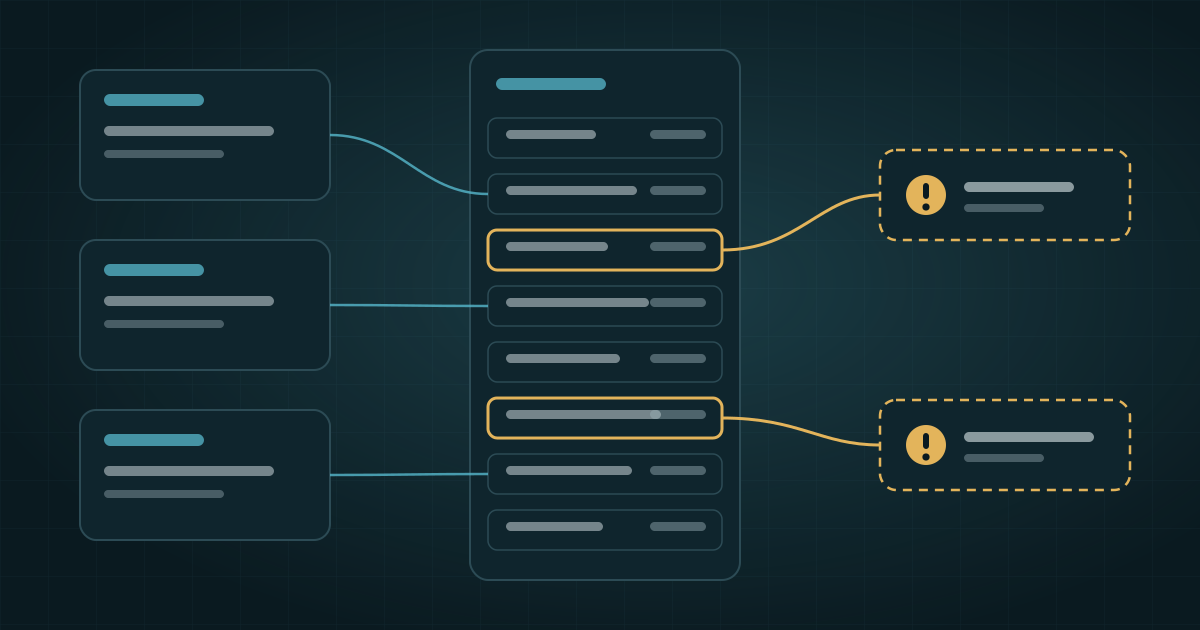
Most of a fieldwork day is not judgement. It is opening a PDF, finding the ledger line it belongs to, retyping the amount, and ticking it off. Judgement is what a firm is paid for; the retyping and vouching is what eats the week. Zimam is built to take over that first pass, and to look at things a tired reviewer can easily miss, while every decision stays with the auditor.
A word on evidence before we start. Every example below comes from our synthetic demo company, a made-up trading company with planted issues, not from a client.
Where the time comes back
- Less vouching by hand. Zimam reads every uploaded document, takes the number, date and amount from it, and links it to its ledger line, showing the place on the page it read. Instead of finding and retyping, you review links and open the source with one click.
- Accept the clear ones together. Readings the system is confident about can be accepted in one step, with a count shown first. The rest wait for a look, and an acceptance can be reversed as a new recorded event.
- The client follow-up, drafted. Missing documents, open questions and unanswered confirmations gather into one request. AI drafts the opening and the closing; the items themselves are inserted by the program, not written by AI. You edit and send it yourself: Zimam sends nothing to the client.
- A materiality draft you accept. AI can propose a benchmark and a percentage with a written reason. The engine computes the amount, and you accept or change it.
- Working papers prepared. The work recorded in the engagement comes out as an Excel working-paper file, so you are not rebuilding it by hand.
What it catches that is easy to miss
These are planted in the demo company so that we can show the product finding them.
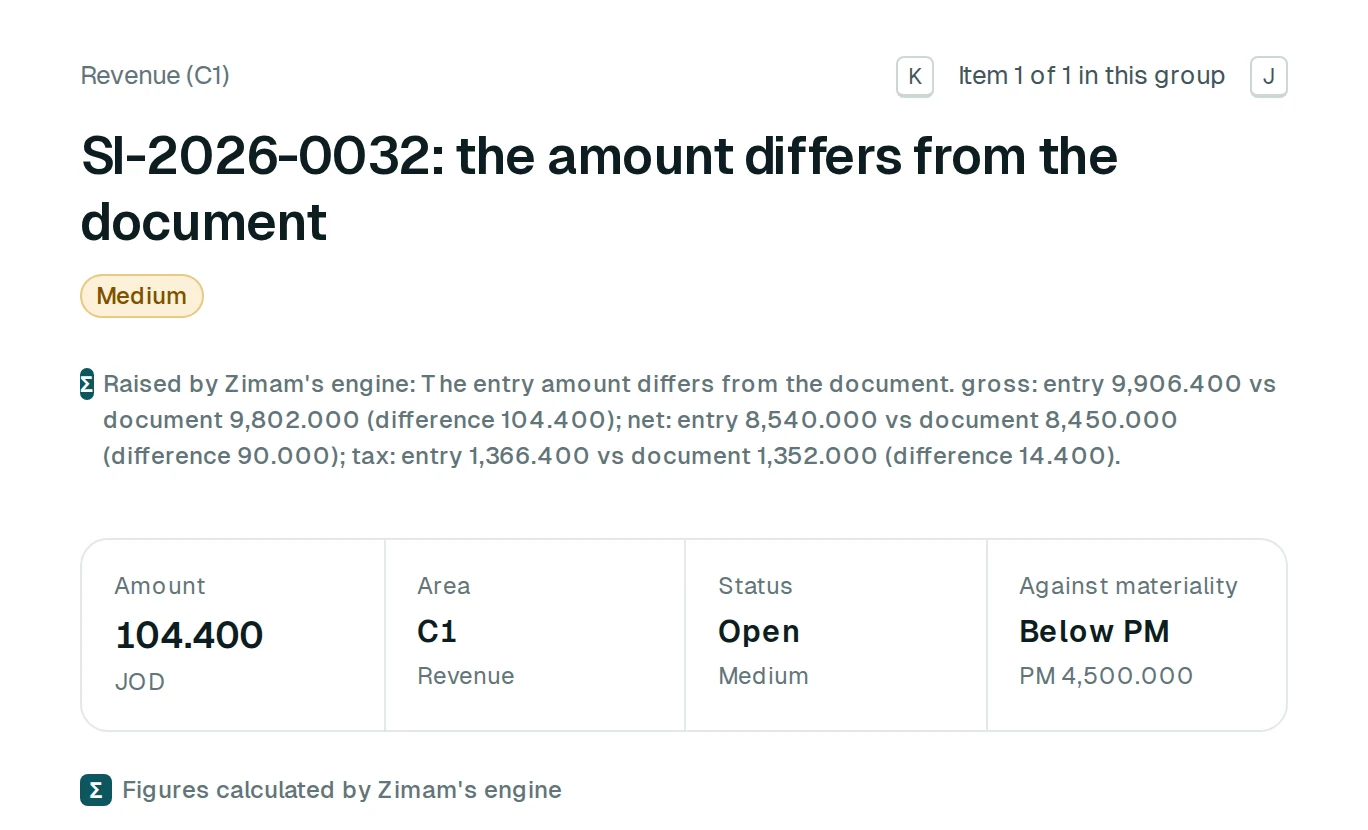
- An invoice that disagrees with the ledger. One sales invoice totals 9,802.000 and the customer paid exactly that, but the ledger entry says 9,906.400. The engine computes the difference, 104.400 (90.000 net and 14.400 tax), and the receivable of 104.400 stays open. Each figure looks plausible alone; it shows only when both sit side by side.
- Tax that does not recompute. An invoice with two lines at 16% prints tax of 806.000; recomputed from the lines it should be 860.000, a difference of 54.000. The ledger, the invoice and its QR code all agree on the wrong figure, so comparing the documents with each other would never show it.
- The same supplier invoice entered twice. It appears once as AF-1187 and once as AF1187, 7,247.564 each, though it was paid once. Zimam normalises the number before comparing, so the different spelling does not hide it.
- Entries that are odd in several ways. A manual entry dated on a Saturday. Another dated in the last days of the period, a round 15,000.000, with only a voucher and no support. Zimam counts the criteria each entry meets (weekend or holiday, round sum, near period end, unusual account pair, manual source) and proposes the entries that meet two or more for you to test.
- Documents that are missing. A sales invoice for 7,888.000 whose delivery note and receipt voucher are on file but the invoice is not; a payment voucher; support for a manual journal entry chosen for testing; the bank confirmation. They go into a request list by priority, ready for the client email.
- A ledger that does not agree with the trial balance. One line of 287.350 is missing from the ledger export, so an entry does not balance and one expense account differs from the trial balance by exactly that amount.
- Payroll that outruns the social security statement. An employee left at the end of May and was still paid in June (700.000); the statement from the social security institution is lower than payroll for that month, and the difference is flagged.
The whole population, not only a sample
The journal-entry tests run over every entry in the ledger, the matching runs over every document uploaded, and the tax recomputation over every invoice that carries an amount, not over a selection. Where a test does call for a sample, the engine draws it by a documented method with a recorded seed, so a reviewer can repeat it and get the same items. Figures, differences and samples come from fixed rules; they are never an answer from a language model.
AI suggests, the auditor decides
A flag is a lead, not a conclusion. Nothing is cleared automatically. What AI reads or drafts stays a suggestion until a named auditor accepts it, and then the record shows who did and when. A difference is closed only by a decision with a comment. Undoing something adds a new event; it never erases the trail.